
Why Do You Need A
Regulated Consultant
Navigating the Canadian immigration system can be complex. A Regulated Canadian Immigration Consultant (RCIC) can provide professional guidance, help you understand your immigration options, and assist with preparing and submitting your application in accordance with current IRCC requirements.
- Understanding of Immigration Pathways: A regulated consultant can assess your circumstances and explain available Canadian immigration pathways, helping you understand which options may be suitable for your situation.
- Professional Representation: An RCIC can represent clients in matters within their authorized scope and communicate with Immigration, Refugees and Citizenship Canada (IRCC) on their behalf when permitted.
- Accurate & Complete Applications: Careful document review and application preparation can help minimize errors, omissions, and inconsistencies that may lead to processing delays or other complications.
Canada permanent residence
Canada offers several pathways to permanent residence (PR) for skilled workers, international graduates, people with Canadian work experience, families, and other eligible applicants.
The right pathway depends on your individual circumstances. Factors such as your age, education, work experience, language ability, occupation, Canadian experience, family situation, job offer, provincial connections, and other eligibility requirements may affect which immigration options are available to you.
At Manpar Immigration, we help clients understand their potential Canadian permanent residence pathways and assist with the preparation and submission of eligible applications.
Explore potential pathways to Canadian permanent residence based on your qualifications, experience, and individual circumstances.
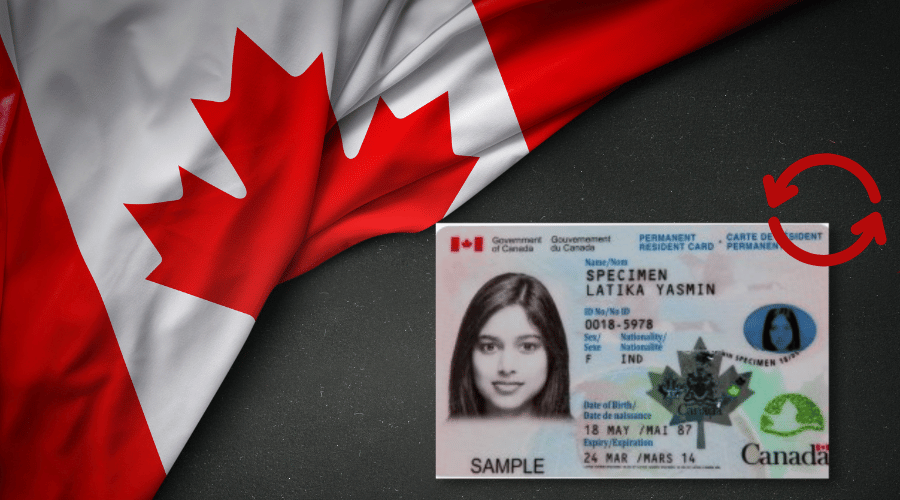
What Is Canadian Permanent Residence?
Permanent residence allows an eligible foreign national to live, work, and study in Canada on a long-term basis while enjoying many of the rights and benefits available to permanent residents.
Permanent residents must meet the applicable residency obligations and other requirements to maintain their status.
Canadian permanent residence is not one single immigration program. There are multiple federal, provincial, regional, and family-based pathways, each with its own eligibility criteria and application process.
Main Pathways to Canadian PR
Express Entry
Express Entry is Canada’s federal system for managing applications from eligible skilled workers under participating economic immigration programs.
Depending on eligibility, candidates may be considered under programs such as:
- Canadian Experience Class (CEC)
- Federal Skilled Worker Program (FSWP)
- Federal Skilled Trades Program (FSTP)
Express Entry may also involve category-based selection, where eligible candidates can be invited based on criteria established by the Government of Canada.
Candidates who enter the Express Entry pool receive a Comprehensive Ranking System (CRS) score, and invitations to apply are issued according to the applicable selection rounds and requirements.
Learn More About Express Entry →
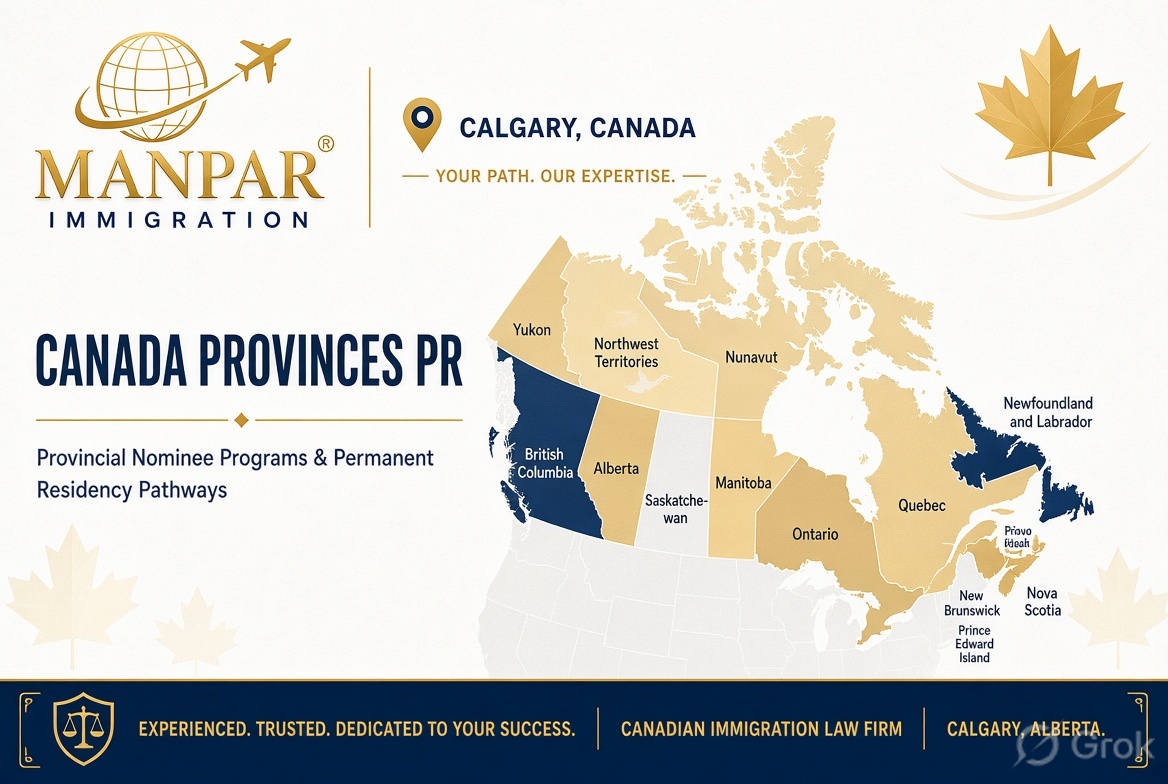
Canada Provincial Nominee programs
Canada’s provinces and territories operate immigration programs that allow them to nominate eligible individuals who meet their regional immigration needs.
PNP options can be particularly relevant for applicants whose qualifications, work experience, occupation, job offer, or other circumstances align with a provincial or territorial pathway.
Manpar Immigration assists clients with provincial programs including:
- Alberta Advantage Immigration Program (AAIP)
- Ontario Immigrant Nominee Program (OINP)
- Manitoba Provincial Nominee Program (MPNP)
- Saskatchewan Immigrant Nominee Program (SINP)
- BC PNP
- Nova Scotia Nominee Program (NSNP)
- New Brunswick Provincial Nominee Program (NBPNP)
- Prince Edward Island PNP
- Newfoundland and Labrador PNP
Provincial programs and individual streams have their own eligibility requirements and intake processes.
Explore Provincial Nominee Programs →
Atlantic and rural pR pathways
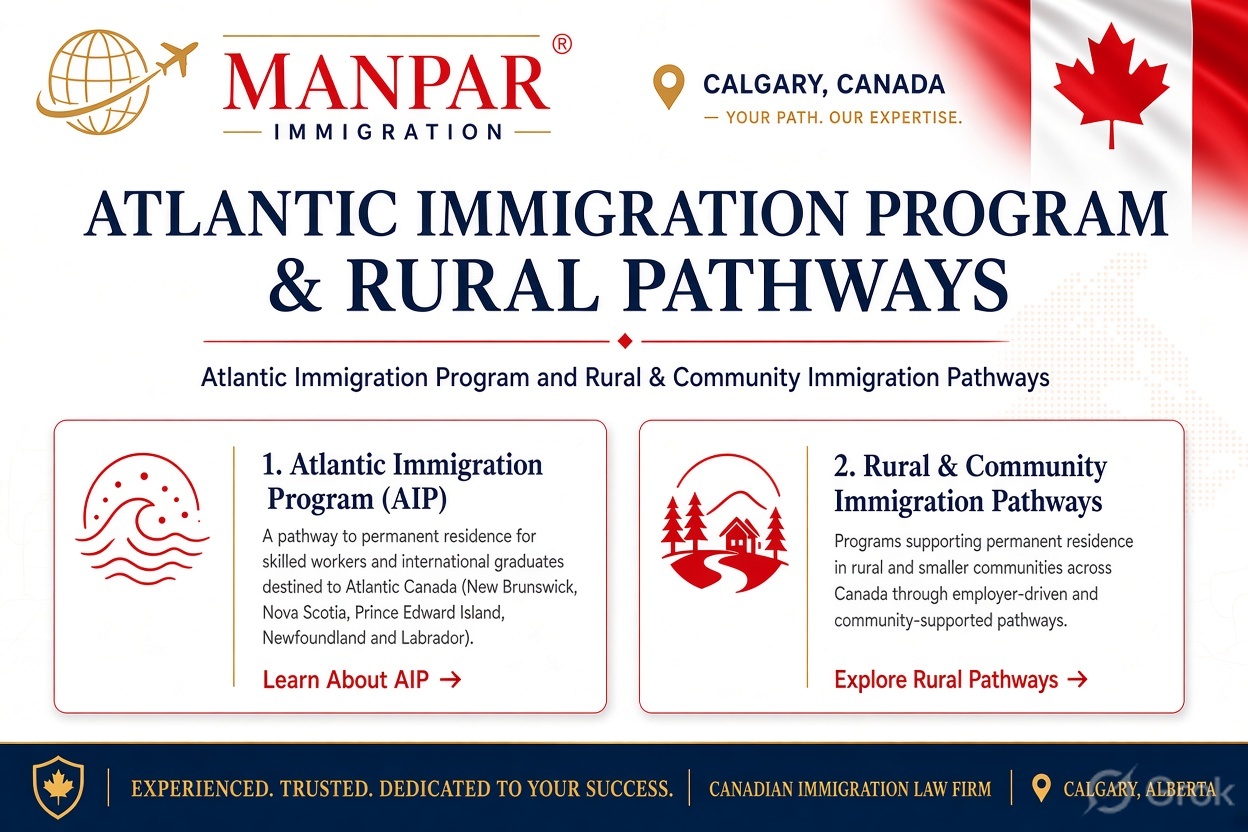
Atlantic Immigration Program
The Atlantic Immigration Program (AIP) provides a pathway to permanent residence for eligible skilled workers and international graduates who meet the program requirements and have an eligible job offer from a designated employer in one of Canada’s Atlantic provinces.
The program covers:
- New Brunswick
- Newfoundland and Labrador
- Nova Scotia
- Prince Edward Island
Eligibility depends on factors such as the applicable work experience, education, language, job offer, and other program requirements.
Learn About Atlantic Immigration →
Rural & Community Immigration Pathways
Canada has introduced immigration pathways designed to support participating rural and smaller communities.
Depending on current program availability, eligible applicants may be able to pursue permanent residence through a participating community-based pathway where they meet the applicable requirements, including employment and community-related criteria.
Program names, participating communities, eligibility requirements, and application procedures can change, so applicants should review the requirements applicable at the time they apply.
Explore Rural & Community Immigration →
family Sponsorship
Canadian citizens and permanent residents may be able to sponsor eligible family members for permanent residence, subject to the applicable sponsorship requirements.
Family sponsorship may include eligible:
- Spouses or common-law partners
- Dependent children
- Parents and grandparents
- Certain other eligible relatives
Family sponsorship has different eligibility, financial, documentation, and relationship requirements depending on the category.
Explore Family Sponsorship →

Which Canadian PR Pathway May Be Right for You?
There is no single PR program that is best for everyone.
Two applicants with similar education and work experience may have very different immigration options because of differences in:
Age
Age can affect eligibility or ranking under certain immigration programs.
Education
Your educational credentials and, where applicable, an Educational Credential Assessment (ECA) can be important to certain economic immigration pathways.
Work Experience
Your occupation, duties, years of experience, location of work, and whether the experience was obtained in Canada or abroad may affect your options.
Language Ability
English and/or French language ability can be an important factor in economic immigration programs and ranking systems.
Canadian Work Experience
Canadian work experience may open or strengthen certain immigration options depending on the nature of your experience and the applicable program requirements.
Job Offer
A qualifying Canadian job offer may be relevant to some federal, provincial, or regional pathways, although not every PR program requires one.
Province or Community
Your current or intended province of residence, employment, employer, or community connection can affect which provincial or regional programs you may be able to consider.
Family Circumstances
Having a spouse, partner, children, or other eligible family relationships in Canada may affect the immigration options available to you.
Start With the Right PR Pathway
Choosing a Canadian permanent residence pathway is an important decision. Applying under the wrong program or overlooking an available option can create unnecessary complications.
Canadian work experience
→ Certain economic pathways may be relevant.
Skilled Foreign work experience
→ May help increase your score and you may target category specific draws.
Strong English + French language skills
→ Express Entry may be worth exploring.
Provincial employment or connection
→ A PNP pathway may be relevant.
Eligible family relationship in Canada
→ Family sponsorship may be an option.
If you are considering Canada PR and are not sure which pathway may fit your circumstances, Manpar Immigration can help you assess your options and understand the next steps.
Contact Manpar Immigration to discuss your Canadian permanent residence options.
Important Information
Immigration programs, eligibility requirements, application procedures, processing times, selection criteria, and government policies can change.
The information on this page is provided for general informational purposes and does not guarantee eligibility or approval of an immigration application.
Eligibility is determined according to the applicable Canadian immigration legislation, regulations, program requirements, and government policies in effect at the relevant time.
What If Your CRS Score Is Too Low?
A lower CRS score does not necessarily mean that you have no possible pathway to Canadian permanent residence.
Depending on your circumstances, you may wish to explore options such as:
- Improving language test results
- Gaining additional qualifying work experience
- Obtaining eligible Canadian work experience
- Exploring provincial nomination pathways
- Considering applicable category-based Express Entry opportunities
- Exploring regional or community-based programs
- Reviewing other eligible immigration pathways
The appropriate option depends on your individual circumstances and the requirements of the programs available when you apply.
Not sure where you stand? Contact Manpar Immigration to discuss your options.
How Manpar Immigration Can Help
Choosing an immigration pathway can be complicated when several programs appear to be available.
Our services can include:
- Reviewing your immigration background and objectives
- Assessing potential permanent residence pathways
- Reviewing education and work experience
- Considering language and other eligibility factors
- Identifying potential federal or provincial pathways
- Reviewing supporting documentation
- Preparing application forms and supporting documents
- Preparing explanations and supporting submissions where appropriate
- Reviewing applications before submission
- Assisting with immigration applications and related correspondence
Our role is to help you understand the requirements applicable to your circumstances and prepare your application carefully.
What Happens After You Choose a PR Pathway?
Although every program is different, a permanent residence application may involve several stages.
1. Initial Assessment
Your circumstances are reviewed to identify potential pathways.
2. Program Selection
The applicable federal, provincial, family, or regional pathway is identified based on your eligibility.
3. Document Preparation
Required forms and supporting documents are collected and reviewed.
4. Application Submission
The application or applicable immigration profile is submitted through the required government process.
FAQs
Canadian PR Frequently Asked Questions
Canada has several permanent residence pathways, including Express Entry, Provincial Nominee Programs, family sponsorship, the Atlantic Immigration Program, and other economic or regional programs.
The appropriate pathway depends on your individual circumstances.
No. Express Entry is an important federal immigration pathway, but it is not the only route to permanent residence.
Provincial nomination, family sponsorship, Atlantic immigration, regional programs, and other pathways may be relevant depending on your eligibility.
Some Canadian permanent residence pathways do not require a job offer, while others may have job-offer requirements or give consideration to employment.
Your options depend on the specific program and your circumstances.
A lower CRS score may make some Express Entry invitations more difficult, but it does not automatically mean that you have no immigration options.
Depending on your profile, you may be able to consider other Express Entry strategies, provincial nomination, regional programs, or other eligible pathways.
International Graduates May Have Several Potential Immigration Options Depending On Their Education, Canadian Work Experience, Language Ability, Occupation, Province, And Other Factors.
Canadian experience may be relevant to certain permanent residence pathways.
Yes. Many Canadian permanent residence programs accept applications from people who are outside Canada, provided they meet the applicable eligibility requirements.
Some permanent residence programs are designed for applicants inside Canada, while others can be used by eligible applicants regardless of whether they are currently in Canada.
Your current status and the specific immigration program matter.
Document requirements vary by program. Depending on the pathway, applicants may need identity documents, language test results, educational documents, work experience evidence, police certificates, medical examinations, proof of funds where applicable, and other supporting documentation.